As an Amazon Associate, we earn from qualifying purchases. Some links on this site are affiliate links at no extra cost to you. Our recommendations are based on thorough research and editorial judgment.


Understanding Filter Thread Sizes and Compatibility

Understanding filter thread sizes and compatibility is essential for protecting our lenses and enhancing image quality. The thread size, like 49mm or 77mm, corresponds to the lens diameter, ensuring proper fit and preventing vignetting, which darkens image corners. We should measure accurately using a caliper, as common sizes vary across brands. Thread pitch, usually around 0.5mm, also affects compatibility and prevents gear damage. By considering these factors, we can optimize our photography setup. Let’s explore more about selecting filters and accessories effectively.
Key Takeaways
- Filter thread sizes, such as 49mm or 77mm, indicate the lens diameter and ensure proper filter compatibility, safeguarding against damage.
- Common filter sizes include 49mm, 52mm, and 77mm, with larger sizes suited for heavier lenses used in specific photography scenarios.
- Thread pitch, typically around 0.5mm, is crucial for preventing cross-threading and ensuring compatibility between lenses and filters.
- Step-up rings enable the use of larger filters on smaller lenses, but can risk vignetting with wide-angle lenses if not checked for compatibility.
- Regular checks for filter compatibility, size, and condition are essential for maintaining optical performance and avoiding light leaks.
What Are Filter Thread Sizes and Why Do They Matter?
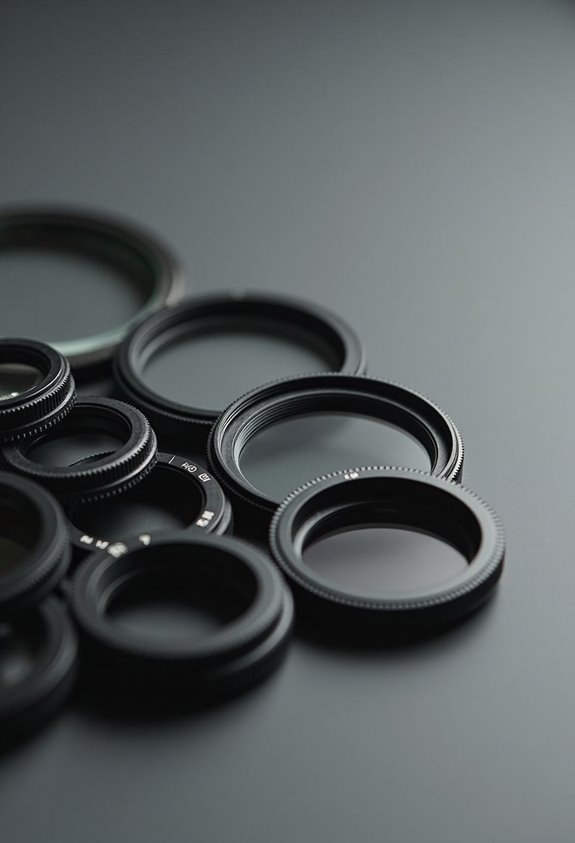
Hey there! So, let’s chat about filter thread sizes. You’ve probably seen terms like 49mm, 52mm, and 55mm thrown around. These numbers actually represent the diameter of the front part of your camera lens, and knowing the right size is super important. If you get it wrong, you might end up cross-threading your filter, which can damage both the filter and the lens, or worse, you could let in unwanted light that ruins your photos.
Here’s why filter thread sizes are a big deal. First off, using the correct filter size ensures that everything works smoothly together, keeping your gear safe. For instance, if you have a lens with a 52mm thread, slapping a 49mm filter on it isn’t just a poor fit; it could lead to vignetting, where the corners of your image go dark.
Then there’s the handy option of step-up rings. They’re great for when you want to use larger filters on smaller lenses. Let’s say you have a 55mm filter but only a 52mm lens; with a step-up ring, you can make that filter work.
Always check your lens diameter marked with the filter diameter symbol to ensure compatibility before purchasing.
How to Measure Your Lens’s Filter Thread Size Accurately

Hey there! So, if you’re getting into photography, knowing how to measure your lens’s filter thread size is super important. It’s actually a pretty simple thing to do, and it ensures that the filters you want to use will fit your lenses perfectly. Start by grabbing a caliper or even just a regular ruler. Measure the diameter of the threaded part of your lens – you want to find that widest point. Most lens thread sizes are measured in millimeters, so you’ll often see sizes like 49mm, 52mm, or 55mm.
When you’re measuring, keep in mind the thread pitch, which is usually around 0.5mm for most modern lenses. This can affect how snugly the filters fit onto the threads. For instance, if your lens measures 52mm, you’ll need a 52mm filter for a perfect fit. It’s a good idea to check your lens’s filter compatibility regularly, especially if you like to mix and match filters or switch between different lenses. You don’t want to end up with a filter that doesn’t fit when you’re ready to shoot!
Using the correct filter size not only ensures a secure fit but also prevents issues like vignetting and optical quality degradation when stacking multiple filters, so it’s crucial to get it right for optimal filter performance.
Recommended Products

Lens Protection & Prevent UV Ray: MCUV filter has two functions, one is to prevent UV ray and weakens the blue tone in images caused by UV, ensuring clarity and color. Another is to protect the lens away from dust and scratches.

Filter Wrench is specially designed for removing jammed or over-tightened filters from your lens. The filter wrench is ideal for detaching all kinds of filters, including UV, CPL, ND, etc

When you buy a new lens with a different diameter, you don't want to buy another set of filters for it.
Overview of Common Filter Thread Sizes

Hey there! So, let’s talk about filter thread sizes in photography. Now that we’ve figured out how to measure those sizes accurately, it’s time to look at some common ones like 49mm, 52mm, 55mm, 62mm, and 77mm. You’ll find that many lenses are designed to fit these sizes, and here’s a fun fact: smaller filter sizes typically belong to more compact lenses, while larger sizes usually indicate heavier setups.
For instance, if you have a nifty little camera with a 49mm filter thread, it’s likely lightweight and portable, perfect for travel. On the other hand, if you’re working with a big 77mm lens for landscape photography, you’re probably set up for some serious captures. Just keep in mind that different camera brands can have their own standards for these sizes, leading to a bit of a mix.
If you ever find yourself wanting to use a larger filter on a smaller lens, don’t worry! Step-up rings are a handy solution; they adapt different sizes to fit together. Just a little heads up, though—sometimes this can cause vignetting, which is when the corners of your photo get darker. Ensuring everything is compatible will definitely make your photography journey much smoother. Let’s move on to discussing filters themselves and how they can elevate your shots!
Using filters made from high-quality materials like AGC glass can significantly improve image clarity and durability.
Recommended Products

Include Step Up Filter Adapter Ring Kit(37-49, 49-52, 52-55, 55-58, 58-62, 62-67,67-72, 72-77, 77-82mm)

[18-Piece Ring Set Contents] - This set includes 18 filter ring adapters, covering 18 size conversions: step-up options (37→49mm, 49→52mm, 52→55mm, 55→58mm, 58→62mm, 62→67mm, 67→72mm, 72→77mm, 77→82mm) and step-down options (82→77mm, 77→72mm, 72→67mm, 67→62mm, 62→58mm, 58→55mm, 55→52mm, 52→49mm, 49→37mm) to meet diverse lens accessory matching needs.

Why Is Thread Pitch Important for Compatibility?
Hey there! You know, understanding thread pitch is super important when it comes to making sure your camera lenses and filters fit together perfectly. Basically, thread pitch is the distance between the grooves on a screw or a lens ring, and it can make a big difference. If you don’t pay attention to thread pitch, you might run into some frustrating issues with your photography gear.
For instance, most modern cameras and filters typically have a standard thread pitch of 0.5mm, but older equipment might have different measurements. If you try to force a filter designed for a different pitch onto your lens, you could end up cross-threading it. That not only damages the threads but can also lead to problems like light leaks or unwanted vignetting in your photos. Ensuring filter compatibility also helps maintain optimal performance and prevents optical distortions.
Recommended Products

Universal Compatibility: SmallRig threaded universal filter adapter is compatible a variety of phone camera lenses, enabling use with 67mm threaded filters or SmallRig 67mm threaded ring LED video lights (ID: 4873) to enhance your shooting capabilities. It makes switching between creative filters and lighting setups easily and meets various shooting needs.

【Convert Screw Filter to Magnetic 】Kase magnetic adapter ring kit provides a simple, cost-effective and effective solution to convert a 82mm screw-in threaded filter to a magnetic filter.

【Upgraded Phone Lens Filter Clip】 This LA006 phone lens filter clip is a true game changer, offering a more thoughtful design for your phone photography and video recording needs with filters. It can accommodate all lenses on most smartphones and works seamlessly with any standard camera lens filter with a 67mm thread
What Are the Advantages and Limitations of Using Step-Up Rings?
Hey! So, let’s talk about step-up rings for camera lenses. They might not be the first accessory you think of, but they can really increase your gear’s versatility. Basically, step-up rings let you use larger filters on lenses that have smaller filter threads. This means you can experiment with all sorts of creative effects without buying a bunch of different sized filters. For example, if you have a 52mm lens but a 77mm filter, a step-up ring can let you use that filter without a hitch.
But, it’s important to keep in mind some limitations. When you use step-up rings on wide-angle lenses, you might see vignetting—those annoying dark corners in your images. Plus, the stability of your filters could be affected, leading to potential issues like light leaks or even damage to your lens if the threads don’t match up just right. So, always double-check compatibility before you grab a step-up ring to ensure everything works smoothly and your equipment stays safe.
Additionally, just as selecting the right ring is key, having the right tools with high measurement accuracy ensures optimal performance and safety.
Next, let’s explore some tips for selecting the right filters and getting the most out of your step-up rings!
Recommended Products

【Aluminium Alloy ing】This step-up ring is made of aluminium alloy not easy to be deformed, and can maintain its performance for a long time, smoothly install and durable.
【Aluminium Alloy ing】This step-up ring is made of aluminium alloy not easy to be deformed, and can maintain its performance for a long time, smoothly install and durable.
【Aluminium Alloy ing】This step-up ring is made of aluminium alloy not easy to be deformed, and can maintain its performance for a long time, smoothly install and durable.
Top Tips for Selecting the Right Filters and Accessories
When you’re out there capturing stunning images, selecting the right filters and accessories can make a world of difference in your photography experience. First things first, always check the filter thread size on your lenses. It’ll usually be something like 49mm, 52mm, or 55mm, and knowing this helps you get the right fit. Trust me, there’s nothing worse than finding the perfect filter only to realize it doesn’t fit your lens!
If you’re looking to use larger filters that don’t match your lens size, consider investing in step-up rings. They allow you to use bigger filters, but be wary of vignetting, where the corners of your photo might appear dark. And while we’re on the topic of filters, don’t forget about the thread pitch—most lenses have a 0.5mm pitch. It’s a small detail that can save you from the frustrating experience of cross-threading your filters.
Now, for ND (Neutral Density) filters, it’s often best to have one for each lens to really optimize your shots. Regularly check for compatibility, and keep those filters clean! This simple habit can significantly extend the life of both your filters and lenses, ensuring you’re always ready to capture that perfect moment. Speaking of moments, let’s chat about how to master different lighting conditions next!
Remember, choosing filters made from high-quality optical glass can greatly enhance image sharpness and reduce glare for better photos.
Recommended Products

Kit Includes: Generic Metal 11pcs Step Up Ring (26-30MM, 30-37MM, 37-43MM, 43-52MM, 52-55MM, 55-58MM, 58-62MM, 62-67MM, 67-72MM, 72-77MM, 77-82MM)

18-in-1 Step Up and Step Down Filter Rings: The smart ring set includes 9x Step-Up Rings (37-49, 49-52, 52-55, 55-58, 58-62, 62-67, 67-72, 72-77, 77-82mm) and 9x Step-Down Rings (49-37, 52-49, 55-52, 58-55, 62-58, 67-62, 72-67, 77-72, 82-77mm). Adapts the thread size of your camera lens to match the thread size of various DSLR camera filters and other accessories. Compatible with Nikon, Canon, Sony, Fujifilm, Olympus, Lumix, Leica camera lenses, and more.

18Pcs 67-82mm metal step up/down filter ring adapter set for versatile lens compatibility,Include Step Up Filter Adapter Ring Kit(37-49, 49-52, 52-55, 55-58, 58-62, 62-67,67-72, 72-77, 77-82mm) Include Step Down Filter Adapter Ring Kit(49-37, 52-49, 58-55, 55-52, 62-58, 67-62,72-67, 77-72, 82-77mm
Frequently Asked Questions
Are #2 or #4 Coffee Filters Bigger?
In our size comparison, #4 filters are bigger than #2 filters. Depending on our brew methods and user preferences, we choose the right filter type to guarantee the best coffee experience tailored to our needs.
How to Know What Filter Size to Get?
To know the right filter size, we should check our lens’s thread type and manufacturer specs. Using photography tips guarantees proper compatibility, minimizing issues like vignetting when utilizing different filter sizes across our equipment.
Does a 52MM Filter Fit on a 50MM Lens?
A 52mm filter doesn’t fit a 50mm lens without a step-up ring. Curiously, 75% of photographers face lens thread differences. We should check filter size compatibility carefully when adapting lens filters to avoid problems.
Are All Filter Threads the Same?
No, all filter threads aren’t the same. Different filter thread types and sizes lead to lens compatibility issues. Plus, filter material differences can affect performance, making standardization challenging across various systems we often use.