As an Amazon Associate, we earn from qualifying purchases. Some links on this site are affiliate links at no extra cost to you. Our recommendations are based on thorough research and editorial judgment.
When to Use UV Filters on Your Camera Drone

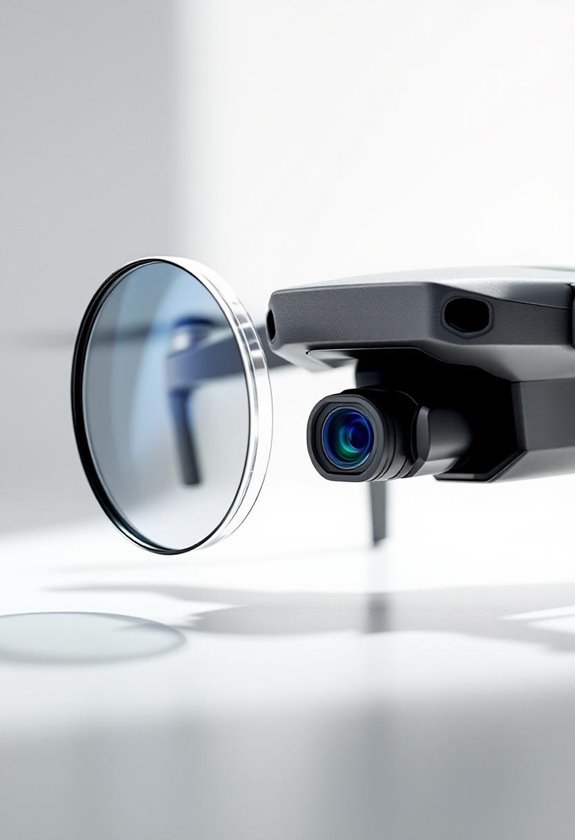
Using UV filters on our camera drones is essential in various environments. We should employ them in bright sunlight to minimize bluish haze, while also protecting against dust, moisture, and scratches, particularly during beach or mountain shoots. They enhance overall image clarity by reducing lens flare and ghosting, making our aerial shots sharper. However, while not always necessary with modern cameras, they still provide valuable lens protection. Let’s explore how to choose the right UV filter for our drone.
Key Takeaways
- Use UV filters on your drone when flying in mountainous areas to combat increased UV radiation and haze in images.
- Attach UV filters during beach shoots to protect against saltwater spray and enhance overall image clarity.
- Employ UV filters in urban environments to shield your drone’s lens from dust and debris.
- Utilize UV filters on sunny days to help avoid bluish haze, improving landscape photography.
- Consider using UV filters in sandy locations to prevent fine particles from scratching the drone’s lens.
The Purpose of UV Filters in Drone Photography

Hey there! Let’s chat about UV filters and why they’re important in drone photography. You might not realize it, but these little guys serve a couple of key purposes. First off, they protect your camera’s lens from dust, moisture, and scratches, especially when you’re flying in tough conditions. Imagine buzzing around a dusty landscape or flying through a light drizzle—having a UV filter can really help keep your lens safe.
Now, there’s a bit of history here. Older cameras struggled with atmospheric haze, and that’s where UV filters played a big role in enhancing image clarity. But with today’s drone lenses being designed differently, we don’t rely on them for that as much anymore. Still, picking high-quality filters is a smart move. For example, they can cut down on how often you need to clean your lens and save you money on repairs if something were to happen.
If you ever experience issues like lens flare from the sun, some advanced filters come with coatings that help minimize those distracting spots in your images. That way, you can focus on capturing beautiful scenes without worrying about your gear. So, whether you’re shooting dramatic landscapes or vibrant sunsets, thinking about UV filters can really elevate your drone photography experience. And speaking of capturing amazing visuals, let’s talk about some tips on composition next!
Choosing filters with multi-layer coatings can also improve light transmission and reduce unwanted reflections, enhancing your overall image quality.
When to Use UV Filters in Specific Environments?

Using UV filters can really elevate your drone photography, especially in different environments. For instance, when you’re flying in the mountains, the thinner atmosphere can increase UV radiation, which can lead to hazy images. A UV filter helps clarify those shots, making your mountain landscapes look crisp and vibrant.
If you find yourself soaring over the coast, a UV filter offers an extra layer of protection against saltwater spray and moisture. It makes cleaning your lens less of a hassle, letting you focus more on capturing those beautiful ocean views. And let’s not forget cityscapes! In urban settings, these filters act like a shield against dust and debris that could smudge your lens.
Now, if you’re flying on a sunny day, a UV filter can prevent that annoying bluish haze that sometimes creeps into landscape photos under bright UV light. Plus, in sandy environments, like beaches, it keeps your lens safe from fine particles that could scratch it. So, whether you’re in the mountains or by the sea, UV filters are definitely worth considering for clear, protected shots. Next, let’s talk about some other useful accessories that can enhance your drone adventures even further!
Additionally, using memory cards with waterproof and shockproof durability ensures that your captured images and videos remain safe even in challenging outdoor conditions.
Recommended Products

CANON USA AUTHORIZED - INCLUDES FULL USA WARRANTY | Pursue Imaging Excellence - The Canon EOS R5 Full Frame Mirrorless Camera features an all-new 45 MP CMOS sensor, 8K DCI video, Dual Pixel CMOS AF II, in-body image stabilization and more, the EOS R5 offers incredible imaging performance for portraits, landscapes, wildlife, cinematography and everything in between.

CANON USA AUTHORIZED - INCLUDES FULL USA WARRANTY | The RF 24-105mm F2.8 L IS USM Z Lens for RF Mount Mirrorless Cameras is the first 24-105mm focal length lens combined with consistent f/2.8 aperture. With its constant f/2.8 max aperture, full-frame coverage, and its ability to zoom past the traditional 70mm roadblock to a true portrait-length 105mm, this lens is an incredible standard zoom solution for many different applications. Even in low light, this lens will excel for weddings and events

SIGMA USA Authorized Model - Includes Full USA Warranty. Performance, reliability, and mobility at its highest level. The flagship SIGMA 70-200mm F2.8 DG DN OS | Sports Full Frame Lens for Sony E-mount, combined with the best of SIGMA's latest technologies to meet the high-level demands of professionals, has finally arrived. Designed to take advantage of the benefits offered by mirrorless camera bodies, including more compact dimensions, in-camera corrections, and improved autofocus technology.
Benefits of UV Filters for Lens Protection

Hey! So, if you’re looking to step up your drone photography game, let’s chat about something really important: lens protection with UV filters. They’re a smart investment for keeping your drone’s lens safe from dust, moisture, and scratches. Imagine being out in a sandy environment—using a UV filter can shield your lens from all that grit, helping it last longer.
Think of it this way: if your filter gets damaged, it’s way cheaper to replace than a whole lens. No one wants to shell out a small fortune just because a little pebble hit their gear, right? Plus, using a UV filter means you won’t have to clean your lens as often, especially when you’re flying around in dusty or windy conditions.
And during those tricky beach shoots or unexpected rain showers, a UV filter is your lens’s best friend. It acts like a shield against the elements, making sure your gear stays in great shape for those incredible aerial shots you’re after. Additionally, choosing a filter with waterproof and sun-resistant materials can greatly extend the protection and lifespan of your equipment.
Recommended Products

Optical Glass: German-made optical glass provides the best possible optics, surpassing or matching any other brand in the industry with color-neutral, scratch-resistant, Waterproof, DustProof, and OilProof coating.

1. Applicable models: Mavic 4 Pro drone with optical glass, material: aluminum alloy + optical glass, multi-layer coating can filter out UV and stray light for clearer image. Made of optical glass, high optical effect and effectively reduces lens flare.

1. target model: DJI Neo2 drone .Material: aluminum alloy + optical glass, multi-layer coating can filter out UV and stray light for clearer images. Made of optical glass, high optical effect and effectively reduce lens flare.
How UV Filters Impact Image Clarity
Hey there! So, let’s chat about UV filters and how they can really shape the clarity of your drone shots. While it’s super important to keep our drone’s lens safe from scratches and smudges, understanding UV filters and their effect on image quality is just as crucial. These filters were originally made to filter out ultraviolet light, which can create that hazy feeling in images, especially if you’re flying over coastal areas or high altitudes.
Even though modern digital sensors don’t pick up UV light as much as older film cameras did, using a UV filter still provides solid protection. Think of it as a shield against dust and moisture that could otherwise ruin your shots. For instance, if you’re flying over a beach, the sand can kick up and settle on your lens, but with a UV filter in place, you can easily clean it off without worrying about damaging the glass.
Also, investing in a high-quality UV filter can help reduce annoying lens flare and ghosting, which improves the contrast and sharpness of your images. Some folks worry that even a good filter might affect image quality due to reflections, but a well-made UV filter can really minimize that. So, when you use UV filters wisely, they can genuinely boost your aerial photography and make your images pop.
Moreover, UV filters often come with multi-layer coatings that reduce flaring and keep the filter surface clean, enhancing image quality even further.
Recommended Products

SIGMA USA Authorized - Includes FULL USA Warranty | Rendering Performance: The Sigma 24-70mm F2.8 DG DN II | Art Lens excels in resolution and sharpness across its zoom range, even on high-res cameras. It enhances visual expression with its F2.8 aperture, producing beautiful bokeh and minimizing focus breathing. Features include advanced close-up capability, 3x faster autofocus than previous model, and resistance to flare and ghosting for high-quality images in diverse conditions.

TAMRON USA AUTHORIZED - Includes Full TAMRON USA WARRANTY

This comprehensive collection includes a variety of essential filters such as ND16 to ND1000 for precise light control, ND16/PL to ND256/PL for morning shots and polarization effects, UV for lens protection, and CPL to reduce glare in challenging lighting. Additionally, this set features specialized filters like the Snow Mist 1/4, which adds a dreamy, ethereal quality to your visuals, and a Light Pollution Filter to capture stunning nightscapes free from artificial light interference. Each filte
Are UV Filters Always Necessary?
Hey, have you ever thought about whether UV filters are a must-have for your camera drone? It’s a good question! While UV filters can certainly help block out pesky ultraviolet light and minimize haziness, their necessity really depends on what kind of shots you’re after. Nowadays, a lot of modern camera lenses come with special coatings that handle UV light pretty well, especially with digital sensors.
However, don’t forget about their protective role! A UV filter can act as a shield against scratches and dust, especially when you’re out in rugged environments like beaches or during a dusty hike. For example, if you’re filming a sunset over the ocean, that UV filter can help keep your lens clear from sand and salt spray.
Still, keep in mind that not all filters are created equal. If you opt for a lower-quality filter, you might notice a drop in image contrast or even some annoying lens flare in your photos. So, before you slap one on your drone, think about where you’ll be shooting and whether the benefits outweigh any potential downsides. In the end, it’s all about what works best for your specific situation! Choosing filters with multi-resistant coating can help maintain image quality and durability while protecting your lens.
Comparing UV Filters With ND and CPL Filters
When you think about filters for drone photography, comparing UV filters to ND (Neutral Density) and CPL (Circular Polarizer) filters is a great starting point. Each of them has its own unique purpose that really shapes the way your photos turn out.
Let’s start with UV filters. They’re primarily here to protect your lens from scratches, dust, and moisture. While they used to be a must-have for film cameras, today’s digital cameras handle UV light pretty well on their own. So, while they’re useful for protection, they’re not as essential as they used to be.
Now, onto ND filters. These bad boys are fantastic when you’re shooting in bright daylight. They reduce the amount of light that enters your camera, which lets you use slower shutter speeds. For example, if you want to create that dreamy motion blur in waterfalls or smooth out the ripples on a lake, an ND filter can help you achieve that without washing out your colors.
Finally, we have CPL filters. These filters work wonders when you want to reduce reflections and glare, especially on shiny surfaces like water or glass. Using a CPL filter can really boost the colors in your shots, making skies look bluer and foliage appear more vivid. Just imagine capturing a stunning sunset over a lake, with the water reflecting the vibrant hues—it’s a game changer.
Additionally, selecting the correct filter size is crucial to ensure a proper fit and optimal performance on your drone camera lens.
Recommended Products

SIGMA USA AUTHORIZED - Includes FULL USA WARRANTY | The new standard for artistic expression. The newest addition to the F1.4 series is the SIGMA 50mm F1.4 DG DN | Art for Sony E-Mount, a large-aperture standard lens designed exclusively for full-frame mirrorless cameras

TAMRON USA Authorized Model - Includes Full USA Warranty. Tamron 28-75mm F/2.8 Di III VXD G2 Lens for Sony E-Mount (Model A063) - Best image quality in standard zoom lens class. The optics have been revamped from the ground up, employing the latest design expertise to develop an optical construction with 17 elements in 15 groups. With two optimally arranged LD (Low Dispersion) and GM (Glass Molded Aspherical) lens elements, optical aberrations are controlled to the maximum degree possible.

TAMRON USA Authorized Model - Includes Full USA Warranty. Tamron 28-75mm F/2.8 Di III VXD G2 Lens for Nikon Z-Mount Mirrorless Cameras (Model A063) - Best image quality in standard zoom lens class. The optics have been revamped from the ground up, employing the latest expertise to develop an optical construction with 17 elements in 15 groups. With 2 optimally arranged LD (Low Dispersion) and GM (Glass Molded Aspherical) lens elements, aberrations are controlled to the maximum degree possible.
How to Pick the Best UV Filter for Your Drone
Hey there! So, you’re looking to pick the best UV filter for your drone, huh? Well, the first thing you want to do is make sure that the filter you choose fits your drone’s lens diameter – it’s kind of like making sure your socks fit your feet! You don’t want to end up with a filter that’s too big or too small.
Next up, opt for high-quality optical glass. This type of glass helps reduce reflections and keeps your images looking crisp and clear. Think about it this way: if you’re flying your drone on a sunny day and your filter is reflecting light all over the place, your photos could end up looking washed out.
Also, consider the thickness of the filter. A thinner profile is usually better, especially if you love capturing wide-angle shots. A thick filter might create vignetting, which is that annoying dark edge effect that can ruin a perfect picture.
It’s also a good idea to check out brands you trust. Established companies like Hoya and B+W are known for producing reliable filters. Plus, make sure to pick a UV filter that’s easy to clean. Drones can kick up dust and debris, so a filter that’s lightweight and easy to maintain will save you time when you’re out shooting.
Remember that camera resolution quality plays a big role in how effective your filter will be in maintaining image sharpness and detail.
With these tips in mind, you’ll be better equipped to find the ideal UV filter for your drone photography adventures! Speaking of adventures, let’s chat about how to adjust your camera settings for the best results with that new filter.
Recommended Products

SIGMA USA AUTHORIZED MODEL - Includes Full SIGMA USA WARRANTY - The Sigma 30mm 1.4 DC DN Contemporary Lens for Sony E-Mount is a high performance prime with a large aperture of F1.4 designed for APS-C Mirrorless cameras. The Contemporary line is part of Sigma Global Vision and is the perfect blend of image quality and compact size.

SMARTLY ENGINEERED FILTER FOR CAMERA CLARITY – Crafted from heat-resistant tempered glass, this UV lens filter minimizes haze and enhances photo sharpness while maintaining accurate color balance. It delivers smooth, high-definition images in every shoot.

Designed for lenses and adapters with a 82mm standard filter thread. Confirm your filter size by locating the "ø" symbol on the lens or lens cap for hassle-free compatibility. This filter has a front and back thread, meaning it can be left on a lens at all times for protection, while still allowing the use of other filters and accessories to thread over top.
Tips for Installing and Caring for UV Filters
Hey there! If you want to get the most out of your UV filters, there are some straightforward installation and maintenance tips you should know. First off, think of installing a UV filter as switching out your lens cap. Just pop it in place, making sure it’s snug; this prevents any pesky light leaks or damage while you’re on the go.
Now, keeping that UV filter clean is super important, especially after a day of shooting outdoors in dusty or humid conditions. So, grab a microfiber cloth and give it a gentle wipe down. This will help avoid any scratches that could compromise your image quality. Before snapping any photos, take a moment to check for fingerprints or dust on the filter and clean it as needed.
When you’re not using your filter, it’s a good idea to store it in a protective case. This simple step can save you from unwanted scratches or cracks. If you ever notice a scratch or crack, don’t hesitate to replace it promptly. This way, you can ensure that your camera lens remains in top shape.
And once you’ve got these tips down, you’ll be ready to capture stunning images with great clarity! Using a durable protective case specifically designed for cameras can significantly extend the lifespan of your filter. What’s next on your photography journey?
Debunking Myths: What UV Filters Really Do
Hey there! Have you ever wondered what UV filters actually do for your camera drone and if they’re really necessary? Sure, they block UV light from hitting your sensor, but their role has changed a bit over time. Initially, they helped eliminate that annoying bluish haze in film photography, but now they serve a few other purposes too.
First off, UV filters can protect your lens from scratches, dust, and moisture, which is super important if you’re flying in tricky conditions. For example, if you’re capturing footage near the beach, sand and salt water can be damaging. Having a UV filter on your lens can save you a lot of hassle and keep it looking pristine. Plus, they can reduce the need for frequent cleaning, especially when you’re out in humid weather.
Some folks worry that using a UV filter could introduce lens flare and slightly affect image quality. But if you choose a high-quality filter, you can keep that impact to a minimum. Ultimately, it comes down to what you value more: protecting your gear or being careful not to scratch the lens. It’s a personal choice that can depend on your shooting habits and environments. Many high-quality UV filters feature multi-layer coatings that reduce reflections and improve color accuracy, making them an even better choice for protecting your lens.
Frequently Asked Questions
When Should I Use an UV Filter on My Camera?
We should use a UV filter when we want to enhance drone image clarity, protect our camera lens, and consider environmental factors. Regularly comparing filter types and maintaining them helps us achieve the best photography techniques.
What Does an UV Filter Do on a Drone?
A UV filter enhances our aerial photography by improving image clarity and color accuracy while protecting the lens. It allows better light transmission and requires minimal maintenance, making it a valuable accessory for our drone.
What Are the Disadvantages of UV Filters?
Imagine a gatekeeper, the UV filter, but sometimes it stifles light transmission. Its drawbacks include color distortion, image quality loss, and extra weight. We should weigh filter cost against these challenges when considering lens protection.
Should I Use UV and CPL Filters Together?
Absolutely, using UV and CPL filters together boosts image clarity in drone photography. The UV filter benefits by protecting our lens while the CPL filter’s advantages reduce light reflection effects, enhancing our captures. Just choose quality filters!